The Photography of Ben Rose
Ben Rose was known for his inventive photographic techniques and his sustained engagement with modern subject matter. For Rose, the making of a photograph was a rigorously technical endeavor, yet one ultimately directed toward shaping the viewer’s perceptual and spatial experience.
Spotlights

Purview
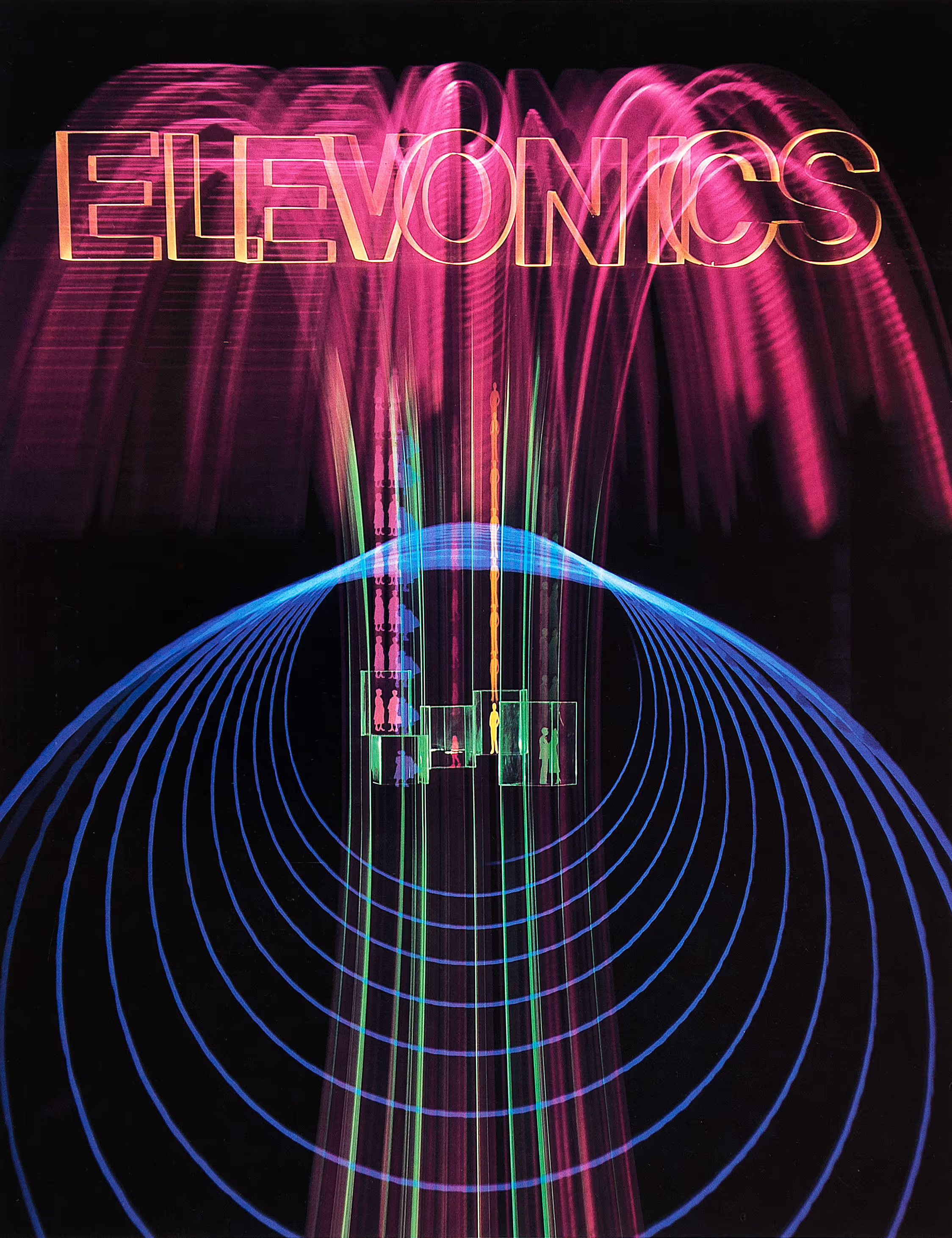
Like most museums, the largest portion of Woodmere’s collection consists of works on paper. Within this area, the museum has made it a priority to collect photographs by Philadelphia artists, including Ben Rose. In the 1940s and 1950s, Rose worked at the forefront of technical innovation in photography, advancing new processes and expanding the medium’s expressive possibilities.
History
Ben Rose was known for his inventive photographic techniques and modern subjects, though his artistic training was rooted in a more traditional foundation. A Philadelphia native, he studied at the Philadelphia Museum School of Industrial Art (later the University of the Arts), where his instructors included the Russian-born photographer Alexey Brodovitch. Rose later returned to teach at his alma mater, as well as at the Parsons School of Design in New York.
Throughout his career, Rose continually experimented with emerging technologies. From 1939 to 1941, he worked primarily with a Contax 35mm camera. Between 1942 and 1947, he shifted to the 2¼ × 3¼ format and began undertaking editorial commissions for magazines such as Harper’s Bazaar, Life, Charm, and Scientific American, as well as for the N. W. Ayer advertising agency in Philadelphia. Around 1948, his work became markedly more abstract; his black-and-white photographs of electrified power lines from this period recall the spatial fragmentation of Cubism, particularly in the work of Marcel Duchamp.
In the early 1950s, Rose turned to Cirkut cameras. As his son, Peter Rose, recalls, “My father began redesigning the motors and using the modified apparatus to make a suite of panorama studies of the New York metropolitan landscape.” In 1954, he experimented with radio and acoustic triggering of speed lights and devised an accurate system for using libration to photograph the moon in stereo. He helped revive and expand the stroboscopic technique in the 1960s, employing early computers of his own design to control complex, Rube Goldberg–like assemblies of camera motors, strobe lights, and turntables to construct what we might now call “virtual” images.
During his tenure as president of the American Society of Media Photographers from 1962 to 1965, Rose organized numerous conferences and colloquia. He also received awards from the Art Directors Clubs of New York, Chicago, Philadelphia, and Detroit.
For Rose, the making of a photograph was an exacting technical endeavor, yet he remained deeply attentive to perception and viewer experience. As Peter Rose observed, his father’s thinking “embodied a desire to summon the conventions of perspective and to make them do some other kind of bidding, to bend the familiars of space into alien figurations, to try to enclose the viewer with a cunning geomancy.”