Chimes, Thomas
Description
Thomas Chimes, a Philadelphia native, studied briefly at the Pennsylvania Academy of the Fine Arts (PAFA) before entering military service in 1942 as an aircraft mechanic. He later completed his studies at the Art Students League in New York City and also philosophy at Columbia University with Joseph Margolis, who later held the Laura H. Carnell Chair of Philosophy at Temple University. Chimes returned to Philadelphia in 1953.
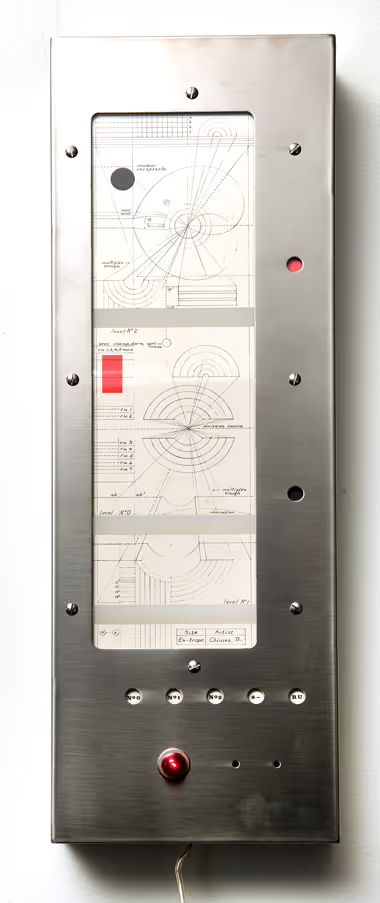
Between the 1950s and 2000s, Chimes produced a diverse, conceptually driven body of work that falls into four phases: crucifixion paintings (1958–65), metal boxes (1965–73), panel portraits (1973–78), and white paintings (1980–2009). He came to understand these phases as alchemical—a yellow phase (crucifixion paintings), red (metal boxes), black (panel portraits), and white (white paintings)—his own variation on the medieval alchemical sequence of black, red, white, and yellow.
Throughout his career, Chimes drew inspiration from a wide range of artistic and literary sources. The visual artists who shaped his work included Vincent van Gogh, Henri Matisse, Thomas Eakins, Max Ernst, Hans Hofmann, and Marcel Duchamp; his literary influences encompassed Antonin Artaud, Alfred Jarry, Edgar Allan Poe, the Marquis de Sade, Carl Jung, Ludwig Wittgenstein, and James Joyce. His work is held in the collections of Woodmere; PAFA; the Philadelphia Museum of Art; the Museum of Contemporary Art, Los Angeles; the Museum of Modern Art, New York; the National Gallery of Art, Washington, DC; the Phillips Collection, Washington, DC; and many others.
We are always open to learning more about our collections and updating the website. We invite you to share your ideas, knowledge, and stories as they relate to the art in our collection. Contact us here.
Please note that work by this particular artist might not be on view when you visit.
Don’t worry—we have plenty of exhibitions for you to explore.
Related Art in Collection