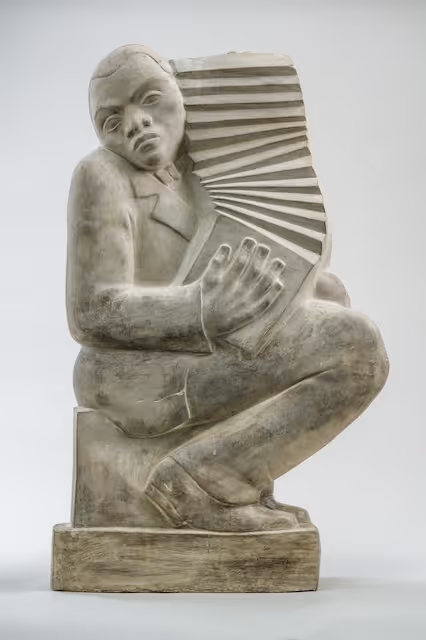
Sardeau’s work is emphatically humanistic, designed to induce contemplation. This Art Deco sculpture of an African American accordion player presents as a block that repeats within itself, conveying serenity and dignity. Note the pleats of the accordion’s bellows and the way the musician rests his head on his shoulder to maintain the streamlined form.
This work relates thematically to Sardeau’s cast-bronze sculpture of a jazz singer exhibited at the 1928 Salon d’Automne in Paris, and to her best-known work, The Slave (1933), a six-foot limestone depiction of a manacled African American, completed for the Central Terrace of the Ellen Phillips Samuel Memorial in Philadelphia’s Fairmount Park. The work was commissioned to accompany sculptures symbolizing “the welcoming of the oppressed from all lands.” The commissioning committee wrote: "Spiritually, there is an association between the freeing of the slaves and the welcoming [of immigrants] to our shores.” The Slave was exhibited at the Museum of Modern Art (MoMA) before its permanent installation.
In addition, Sardeau’s terra cotta sculpture The Lovers (1937) was included in MoMA’s Three Centuries of American Modernism (1938), which also traveled to the Musée du Jeu de Paume in Paris. In 1942, Brazil's Minister of Education commissioned Sardeau and George Biddle for sculptural reliefs and mural paintings, respectively, at the National Library in Rio de Janeiro. In 1949, Sardeau was among 254 sculptors who exhibited in the 3rd Sculpture International at the Philadelphia Museum of Art.