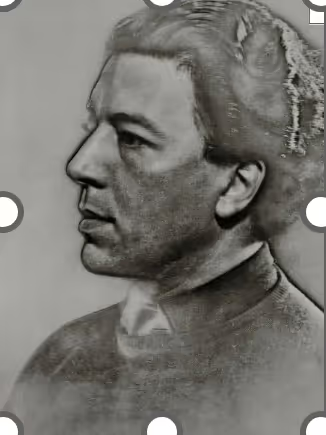
Man Ray’s photogravure—a type of print that combines photography and intaglio etching—captures his friend André Breton in contemplative profile. Breton, a poet and a founder of the surrealist movement, wrote the movement’s manifestos and championed automatic writing and dream imagery as pathways to the unconscious. Man Ray’s soft-focus treatment and dramatic side-lighting transform the portrait into something dreamlike, suggesting the visionary quality of his subject’s mind while revealing the intimate bond between photographer and poet within surrealism's revolutionary circles.
Man Ray, born Emmanuel Radnitzky in Philadelphia, emerged as one of the most inventive and elusive figures of twentieth-century art. A painter, photographer, filmmaker, and constructor of objects, he dazzled with the multiplicity of his talents and his refusal to be confined by medium or style. Early in his career, he described himself as a “Thoreau breaking free of all ties and duties to society,” embracing modernist ideas he encountered in New York City at Alfred Stieglitz's Gallery 291 and the groundbreaking 1913 Armory Show.
After nearly a decade in New York's modernist circles, Man Ray followed his friend Marcel Duchamp to Paris in 1921, where he became central to the Dada and surrealist movements while also pursuing fashion and portrait photography. He embraced found objects, inventing the conceptually charged “readymade” in his own work, and pushed the boundaries of photography with his “rayographs” and experiments in film.