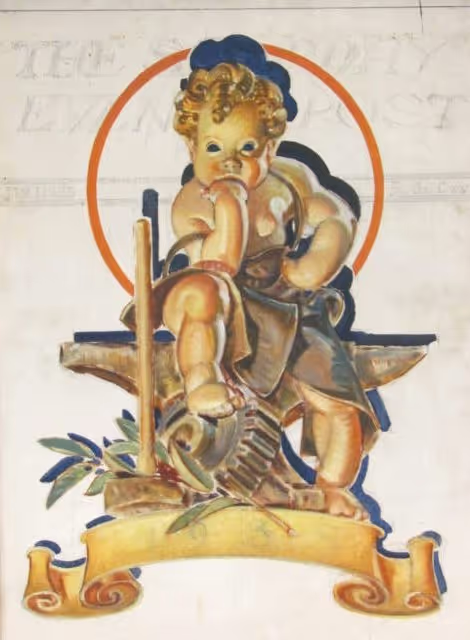
Leyendecker’s cherubic babies graced the covers of the Saturday Evening Post’s New Year’s issues thirty-seven times, ushering in each new year from 1907 to 1943. While the earliest New Year’s Babies simply embodied innocence, they gradually came to express the nation’s social and political concerns. The 1938 Baby New Year sits atop an anvil in the contemplative pose of Auguste Rodin’s Thinker, one foot resting on an iron gear. Three years before the US entered World War II, the anvil and a hammer allude to the hope that weapons of war might yet be “beaten into plowshares,” while an olive branch symbolizes a yearning for peace.
Leyendecker was born in Montabaur, Germany, and immigrated to the United States with his family at the age of eight. Showing an early interest in art, he began working at sixteen in a Chicago engraving house while studying in the evenings with John H. Vanderpoel at the School of the Art Institute of Chicago. After five years of saving, he fulfilled his dream of studying at the Académie Julian in Paris.
Upon his return to the US, Leyendecker quickly became one of the most sought-after American illustrators, producing advertising images and magazine covers for leading publications. His first Saturday Evening Post cover appeared in 1899; over the next four decades he completed more than three hundred others, including his beloved annual New Year’s Baby series. He was inducted into the Society of Illustrators’ Hall of Fame in 1977. A major retrospective of his work was held at the Norman Rockwell Museum in 1997–98.