In 1927, the British artist Stanley William Hayter founded Atelier 17, an experimental workshop for printmaking and the graphic arts in Paris that would attract avant-garde artists like Pablo Picasso, Georges Braque, Joan Miró, and Alexander Calder.
In the years immediately following World War II, from 1945 to 1950, Hayter taught printmaking at the New School in New York, where his students included Jackson Pollock and Mark Rothko. During these years, he also taught at the Print Center in Philadelphia, becoming an important mentor to many artists and inspiring a great florescence of the print as an art form in the city.
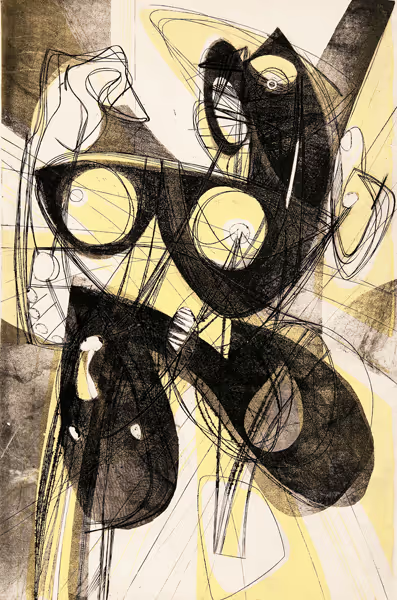
This print, Ceres, of 1948 depicts the Roman goddess of the harvest screaming in a monster-like rage, perhaps a response to the recent horrors of war. This work became well-known in Philadelphia after it was exhibited at the Pennsylvania Academy of the Fine Arts later that year.

![[Untitled (Still Life)]](https://cdn.prod.website-files.com/68961b6b3189b29172d19dc9/691c6cbd1ab83645fa0fdfee_Piper_2007.32_WEB-1.avif)