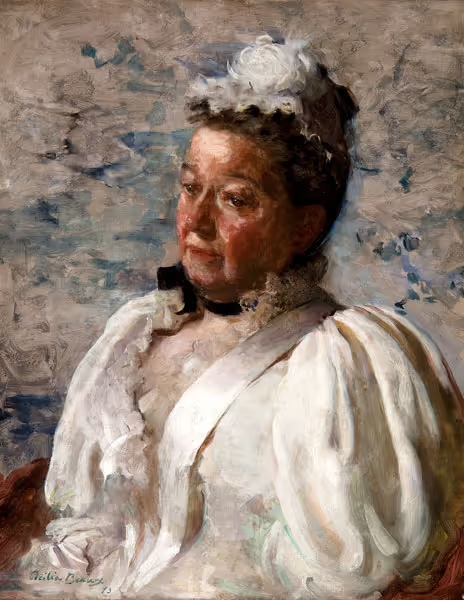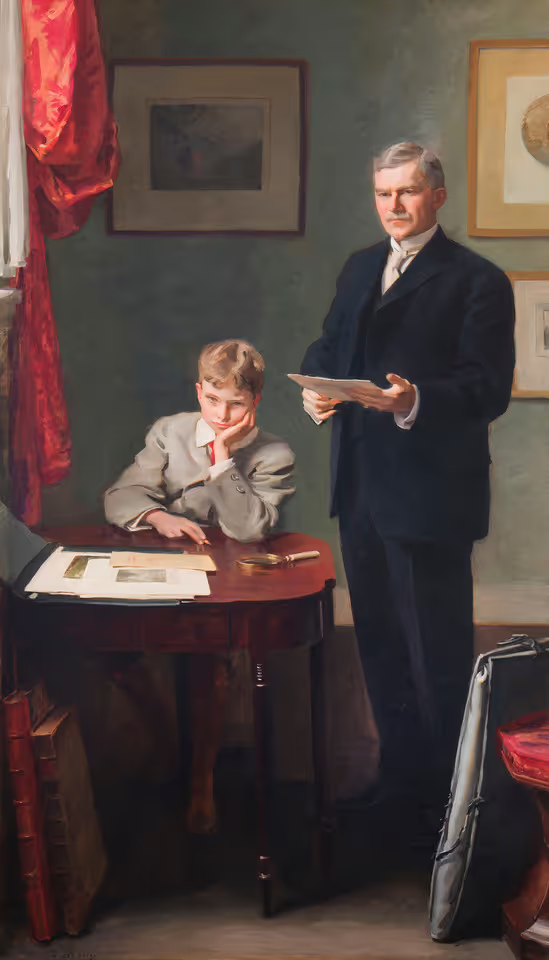
John Frederick Lewis and Son, Alfred Baker Lewis is one half of a double portrait. Its companion, Mrs. John Frederick Lewis and Her Son, John Frederick Lewis, Jr., is in the collection of the Amon Carter Museum of American Art in Houston.
John Frederick Lewis was a distinguished Philadelphia attorney and philanthropist. He and his wife, Anne, supported a broad range of cultural and educational causes across the city—for example, he served roles as president of the Pennsylvania Academy of the Fine Arts (PAFA), the American Academy of Music, and the Philadelphia Art Alliance. Beaux’s double portrait conveys the Lewises’ focus on their children, whom they prepare to inherit the responsibilities associated with their position in society. In Woodmere’s painting, their older son, Alfred, is depicted with his father in the midst of what seems to be a private lecture on art, based on the presence of a canvas folio, a stack of prints, a magnifying glass and two formidable books. While the drawn red curtain and subdued sunlight recall allegorical portraits by Old Masters such as Vermeer, Beaux adds the amusing touch of Alfred’s reluctant endurance of his lesson, tapping his fingers on the table out of boredom.
A Philadelphia native, Beaux was raised by her maternal grandparents and supported by her aunts who recognized her emerging artistic talents. She received instruction from her relative Catherine Ann Drinker, an accomplished artist who would be a lifelong inspiration. Beaux also trained with Dutch-born academic painter Francis Adolf van der Wielen. By 1875, she was working as a commercial artist, including making drawings of fossils for the U.S. Geological Survey project. Then, from 1877–79, she studied at the Pennsylvania Academy of the Fine Arts (PAFA). After that, she taught private art lessons at Miss Sanford’s School in Hockessin, Delaware, and trained privately with the painter William Sartain.
In 1888, after rejecting a marriage proposal from Philadelphia artist Henry Thouron, Beaux decided to devote herself to portraiture and studied in Europe for nineteen months. “I have let myself enjoy your friendship too much,” she wrote to him before leaving on her travels. She was able to hone her skills in Paris at the Académie Julian (est. 1868) and Académie Colarossi (est. 1870) in Paris, the only art academies in the city to accept women at this time. She spent much of her time in Paris visiting the Louvre, copying old masters and admiring works by Italian and Dutch artists like Titian, Rembrandt, and Peter Paul Rubens. “I have been copying at the Louvre, and I am infatuated with it,” she wrote.
Beaux was the first woman to secure a faculty position at PAFA. Among her students was the great American muralist and illustrator Violet Oakley. Beaux taught classes from portraiture to life, costume, and antique copying in the 1870s. Critics were soon describing her work as “virile” and “strong,” comparing her canvases to those of John Singer Sargent. Her work Les derniers jours d’enfance (The Last Days of Childhood) was exhibited in the Paris Salon following its debut at PAFA in 1885, as were other works at the Champ-de-Mars Salon in 1896. Beaux continued to be celebrated in Philadelphia and New York for her portraits of established families, and her talents were recognized by the leading critics and institutions of her day.