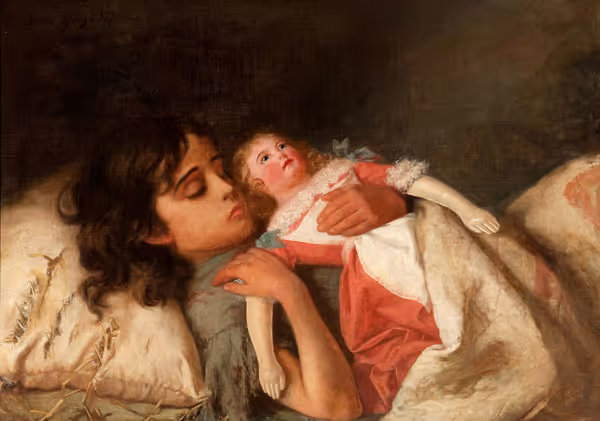
Waugh captures a quiet moment between a child—Little Cosette—and her doll in a soft, warm light. The artist draws attention to Cosette’s hands, gently curved to cradle the doll. She evidently took inspiration from the character Cosette in Victor Hugo’s Les Misérables, who receives a doll on Christmas Eve from the protagonist Jean Valjean. Valjean feels sympathy for the mistreated child, and later adopts her. Cosette’s torn pillowcase and tattered sleeve contrast poignantly with her doll’s porcelain-like skin, blushing cheeks, and beribboned dress. Little Cosette is a visual reminder that one act of kindness can set the course for future rewards.
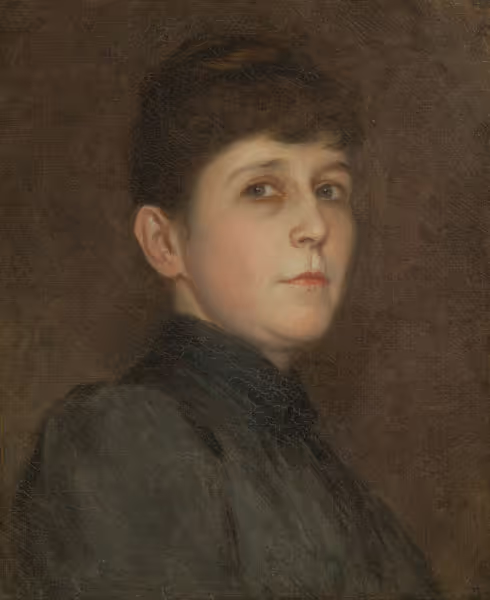
Waugh was born in Philadelphia and trained at home by her father, the prominent portrait artist Samuel B. Waugh. She subsequently studied at the Pennsylvania Academy of the Fine Arts (PAFA) and the Académie Julian and the Académie Delécluse in Paris. Her paintings are rare, but she was acclaimed for her religious subjects and allegorical works. She exhibited in the “Women’s Building” of the 1893 Chicago Columbian Exhibition with fellow Philadelphia native Mary Cassatt and collaborated as illustrator of the children’s books written by her life partner, Amy Ella Blanchard. Titles include Ida Waugh’s Alphabet Book (1888), The Butterfly (1891), and Holly Berries (1881). One of Waugh's paintings, Hager and Ishmael, was exhibited at the 1888 Paris salon; and her portrait of Dr. Paul J. Sartain, son of Philadelphia engraver and printmaker Samuel Sartain, won an award from the National Academy of Design in 1896. Waugh’s half-brother was the well-known marine painter Frederick Judd Waugh, whom Amy Ella Blanchard taught at the Waugh residence at 4100 Pine Street in Philadelphia. When not in residence on Pine Street, Ida and Amy lived in the Lower East Side, Bailey Island, Maine, and Redding Ridge, Connecticut.
![[Untitled (Still Life)]](https://cdn.prod.website-files.com/68961b6b3189b29172d19dc9/691c6cbd1ab83645fa0fdfee_Piper_2007.32_WEB-1.avif)