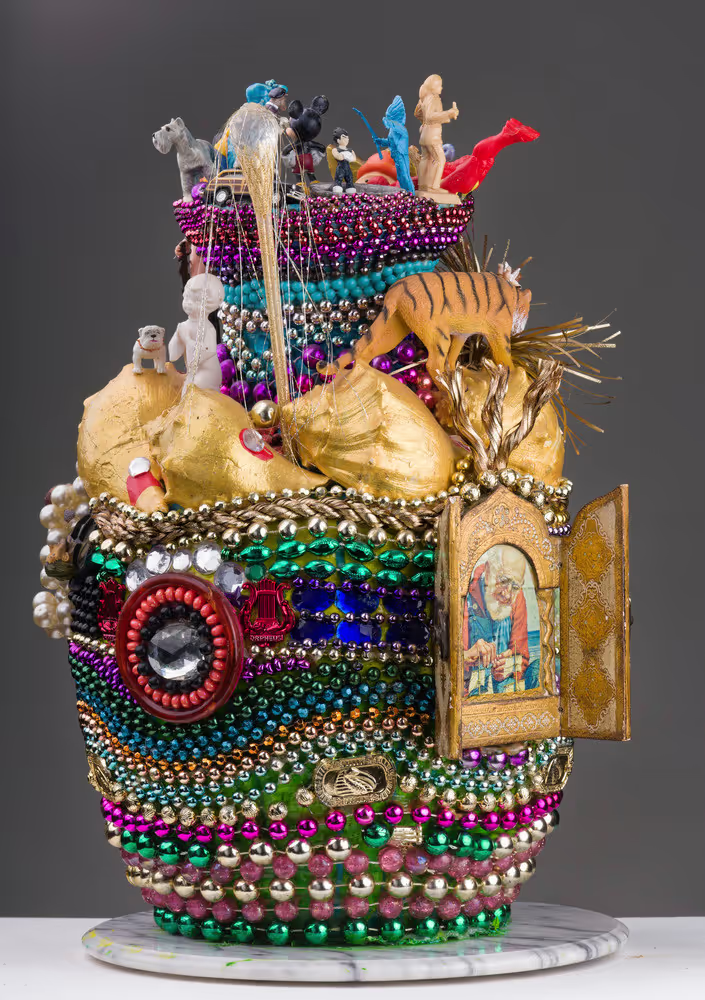
Throughout his career, Stubbs embraced the camp aesthetic of American gay culture. His urns function as hieratic, ritualistic reliquaries—this one complete with a folding, Gothic-style altarpiece. Stubbs also drew inspiration from non-Western sources, especially the joyous decorative objects he encountered while traveling in India. In the lower part of the urn, horizontal bands of beads suggest gemstones, or the stratified layers of earth in which ancient objects are embedded. A plastic tiger walks on a landscape of gold conch shells, while pop culture figures including Mickey Mouse and Vampirella—a queer icon—sit atop the urn like gods on Mount Olympus.
Stubbs additionally created spectacular jewelry, crowns, and hats, which took many forms and were, perhaps, the most physical example of the artist’s generosity and love. Every February, he made valentines in the form of pins and delivered them to friends all over Philadelphia. Julie Courtney, an art curator and close friend, said Stubbs transfigured his ersatz collection of found items into something beautiful. “He had a great eye,” she said. “What most people would think of as mundane, everyday materials, he would imagine something fantastic.”
Born in Reading, Pennsylvania, Stubbs was a painter, sculptor, jewelry maker, and quilter. He was introduced to art through evening lessons in his family’s kitchen with his sister, Pam. After graduating from Reading Senior High School in 1966, he was drafted into the U.S. Army. As a conscientious objector, he served as a field artist in Vietnam, where he painted, taught art and photography, and escorted celebrity performers at USO shows. After his discharge in 1970, Stubbs earned a certificate in painting from the Pennsylvania Academy of the Fine Arts (PAFA) in 1972.
Beginning in 1974, Stubbs taught art classes for visually impaired students at the Philadelphia Museum of Art and, from 1986 to 2000, at the Senior Adult Activity Center in Norristown. He also taught at the Institute of Contemporary Art (ICA), the Philadelphia Art Alliance, and Rowan University. In 1998 he consulted with Charles L. Blockson on a commissioned portrait of Paul Robeson for the centennial of Robeson's birth; he researched and made hundreds of sketches until the portrait was completed and dedicated at the Paul Robeson House in 2012.
Stubbs’s work is held in numerous public collections, including Woodmere, the Museum of Fine Arts in Houston, the Los Angeles County Museum of Art, the Design Museum Den Bosch in the Netherlands, the Paul Robeson House, the Hermitage in St. Petersburg, the Stedelijk Museum in Amsterdam, the African American Museum in Philadelphia, the Pennsylvania Convention Center, and the Library for the Blind in Philadelphia.