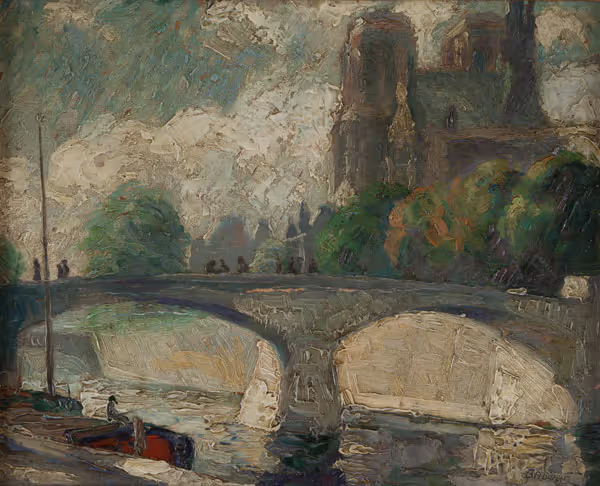
Badura’s depiction of Philadelphia’s skyline from the Schuylkill River’s west bank visually rhymes with his Parisian cityscape of Notre Dame Cathedral on the Seine. Here, though, modern industry is the engine of the composition. The rounded white brushstrokes in the foreground are train cars passing along the regional rail lines. Dark red strokes spiral in wide puffs from the train cars’ rooftops; in the background, factories emit gray smoke. A yellow school bus and a black automobile pass over a bridge that bisects the canvas. The apex of the scene is the hazy figure of William Penn atop City Hall. Zoning laws in Philadelphia did not allow other buildings to surpass its roughly 500-foot height until 1987.
Born in Milwaukee, Badura studied at the Wisconsin State Normal School for Teachers and the Pennsylvania Academy of the Fine Arts (PAFA). In 1928 he married fellow PAFA student Faye Swengel and the couple settled in New Hope. Although he was a gifted painter and stained-glass artist, Badura is best known as a frame maker. He left behind a legacy of hand carved and gilded masterpieces that can be found surrounding the works of Daniel Garber, Edward Redfield, Fern Coppedge, and many others. Badura’s work has been exhibited at the Connecticut Academy of Fine Art, the Corcoran Gallery, the National Academy of Design, the Cincinnati Art Museum, and the Virginia Museum of Fine Art, among other venues. He is represented in the collections of Woodmere and the Michener Art Museum as well as many private and institutional collections.
![[Untitled (Still Life)]](https://cdn.prod.website-files.com/68961b6b3189b29172d19dc9/691c6cbd1ab83645fa0fdfee_Piper_2007.32_WEB-1.avif)