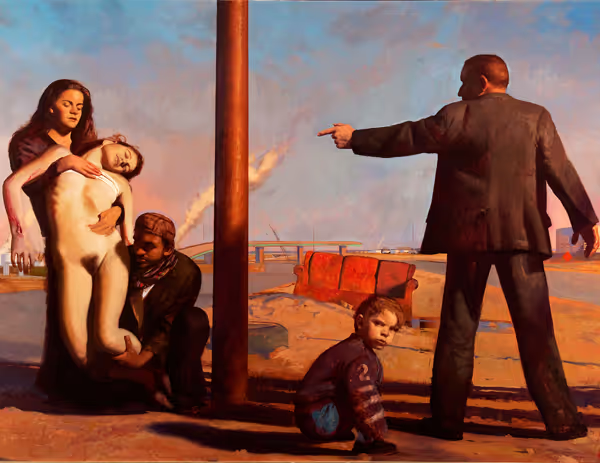
Bartlett’s monumental painting recalls historical masterpieces Western art, such as Rogier van der Weyden's Crucifixion (c. 1460) at the Philadelphia Museum of Art. Yet Bartlett confronts us with a disturbing contemporary narrative. Five life-size figures pose dramatically in a deserted, industrial landscape. Scattered objects—a wheel, a discarded sofa—and the looming oil tanks and unfinished highway situate the scene in a world where industry and nature uneasily coexist. On the right, a man with his back turned points his finger like a gun toward the figures on the left. There, a woman cradles a lifeless body whose pose and stigmata-like wounds evoke the dead Christ. At far right, a small boy fixes us with an accusatory stare. Does his gaze implicate us in the violence? Or does it rebuke our intrusion into a private, even sacred moment?
Bartlett’s imagery evokes a desolate world populated by victims, perpetrators, and those who respond with compassion. He studied in Italy with Ben F. Long IV before attending the University of the Arts and the Pennsylvania Academy of the Fine Arts (PAFA). He also studied with Nelson Shanks at PAFA, took anatomy at the Philadelphia College of Osteopathic Medicine, and later pursued filmmaking at New York University. Bartlett’s honors include a Pew Fellowship in the Arts, several awards for his documentary Snow Hill on Andrew Wyeth, and the Ursinus College Distinguished Artist Award.

![[Untitled (Still Life)]](https://cdn.prod.website-files.com/68961b6b3189b29172d19dc9/691c6cbd1ab83645fa0fdfee_Piper_2007.32_WEB-1.avif)